climate change
Planted Feb 2021 Tended 10 days ago Linked from 15 notes
Contents
Climate change’s existential threat is not hypothetical. It is killing people now. (Dr. Leah Stokes)
I trust the evidence of my own experience, the science and delegates from 196 nations of Earth that human-induced climate change is a real, urgent, and accelerating crisis that demands concerted, systemic action on the part of humanity. In a perverse reading of William Gibson's quote that "The future is already here, it's just not evenly distributed," the most vulnerable among us have already been suffering the consequences (see also: The climate disaster is here), and the relative wealth and privilege which insulates people like me from those consequences won't do so forever.
We've known about human-induced climate change for more than a century
A 1912 newspaper article clearly explains the mechanism by which burning fossil fuels warms the earth:
The furnaces of the world are now burning about 2,000,000,000 tons of coal a year. When this is burned, uniting with oxygen, it adds about 7,000,000,000 tons of carbon dioxide to the atmosphere yearly. This tends to make the air a more effective blanket for the earth and to raise its temperature. The effect may be considerable in a few centuries.
Even ExxonMobil was a public pioneer climate change research in the 1970s before a strategic shift in the '90s toward climate change denial in which they adopted the strategy (and same PR firms) as big tobacco to mislead the public about the causes and magnitude of climate change.
Climate Change is affecting our brains
See this 2026 report from the Neuro Climate Working Group on the effects of the climate crisis on our nervous systems—including air pollution, trauma, heat, and more.
What Humanity Needs to Do
We're beyond the point at which we can avert disaster by merely reducing future emissions. Now, we also need to revert past emissions by pulling CO₂ out of the air. Here's a deep but accessible primer on carbon capture
We need to democratize survivability
Clive Hamilton in Requiem for a Species:
Vigorous political engagement aimed at collectively building democracies that can ensure the best defense against a more hostile climate, ones that do not abandon the poor and vulnerable. For we should remember that once the dramatic implications of the climate crisis are recognized by the powerful as a threat to themselves and their children, they will, unless resisted, impose their own solutions on the rest of us, ones that will protect their interests and exacerbate unequal access to the means of survival, leaving the weak to fend for themselves. This is how it has always been. We must democratize survivability.
What I'm Doing
What I'm doing about climate change
Preparing for the Future
Environmentalist Bill McKibben suggests perhaps the most important thing we can do to prepare for climate change is live in a place with a high degree of social trust (and take steps to shore up that social trust as much as possible):
We’ve come through 75 years where having neighbors was essentially optional: if you had a credit card, you could get everything you needed to survive dropped off at your front door. But the next 75 years aren’t going to be like that; we’re going to need to return to the basic human experience of relying on the people around you. We’re going to need to rediscover that we’re a social species, which for Americans will be hard.
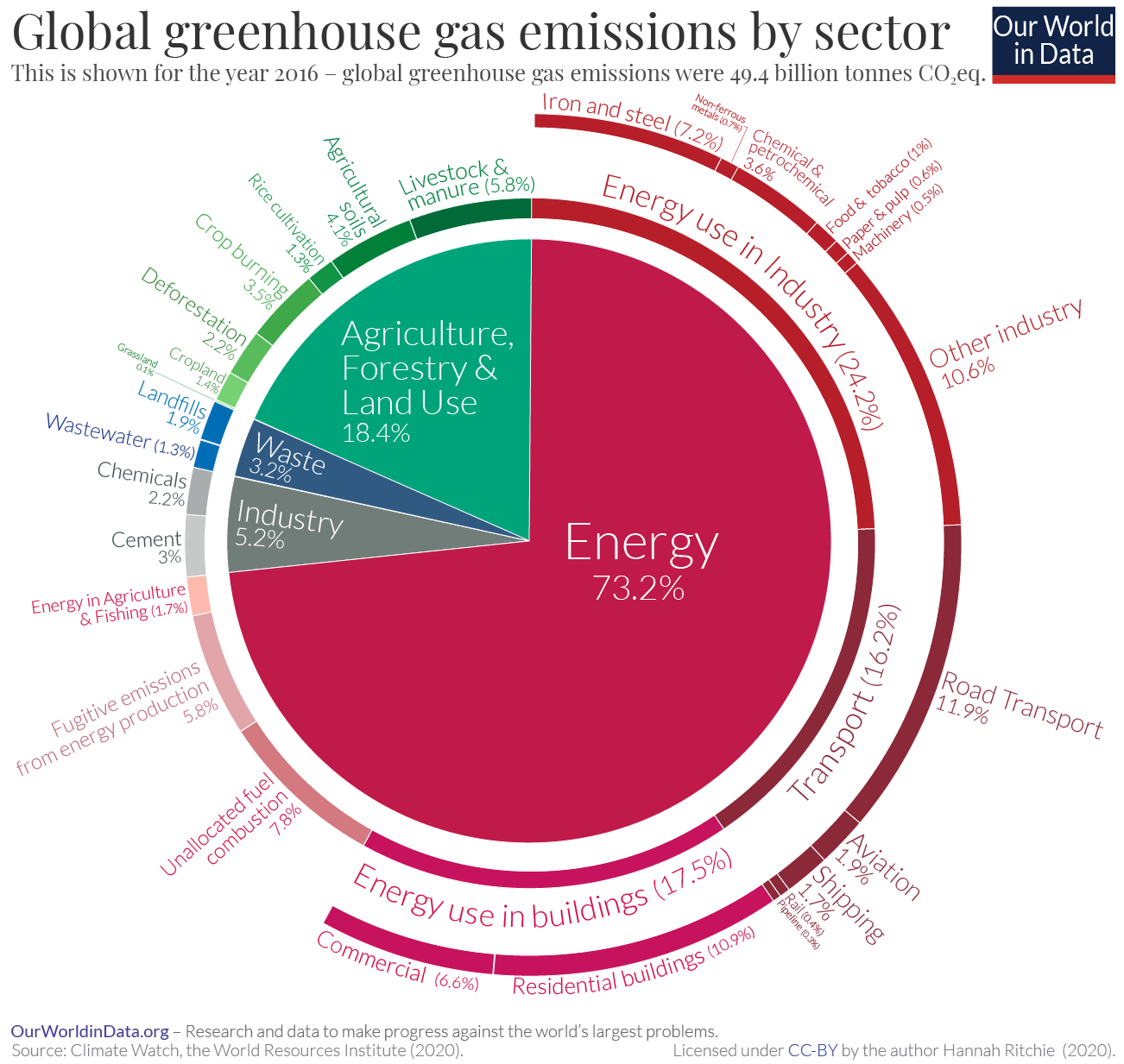
Emissions by Industry